



Myth-Busting Knee Nutrition: Bone Broth, Nightshades and Other Claims Examined
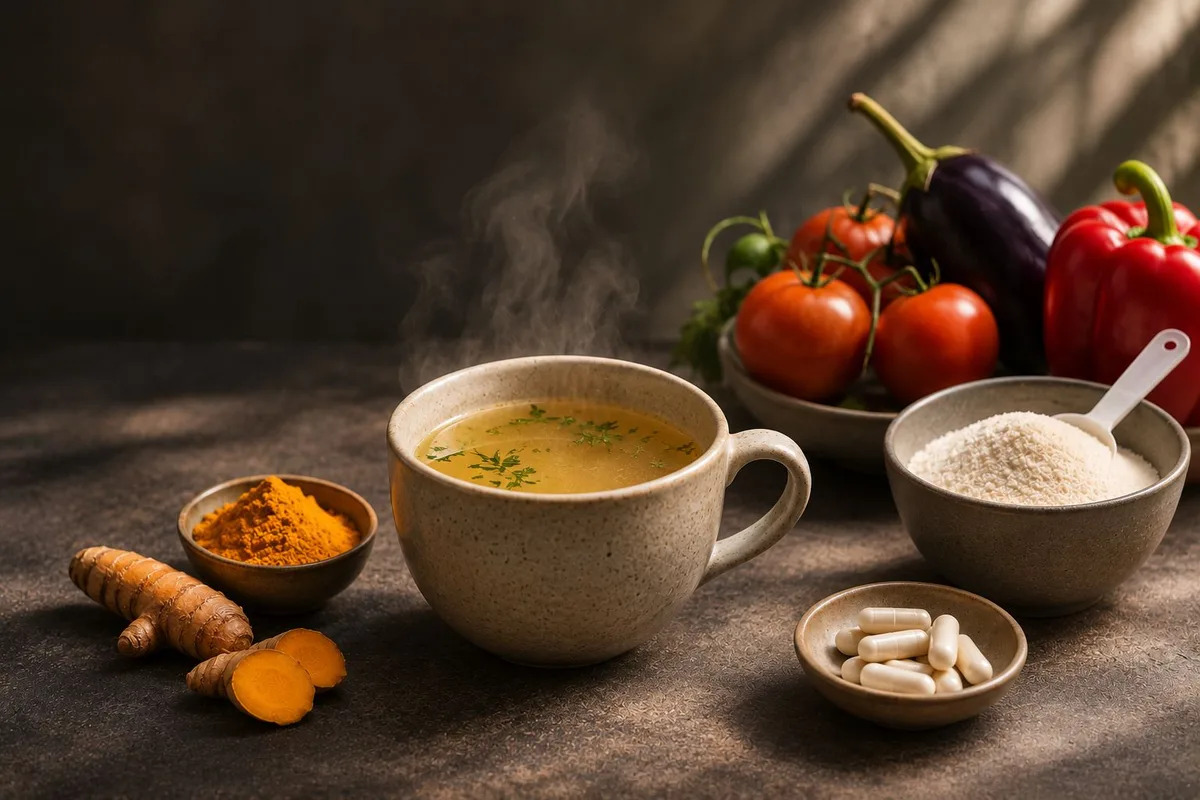
“Will bone broth rebuild her cartilage?” “Should Papa stop eating tomatoes and baingan?” “My friend swears by a collagen powder.” As the clinical nutritionist at Kneesy Health, these are the kinds of questions I hear from people with knee pain and their families.
When a knee hurts, food feels like something you can control, so I understand why these claims spread so fast on WhatsApp and social media. But some have little evidence behind them, and a few can lead you to cut out healthy food or spend money for no benefit. Here is what the research actually says, claim by claim.
First, the honest bit
No food, broth or supplement has been shown to rebuild worn knee cartilage or cure arthritis. What you eat matters mainly in two ways: it affects your body weight, which loads your knee with every step, and it shapes your overall eating pattern. In an 18-month trial of overweight and obese adults with knee osteoarthritis (OA), diet plus exercise gave the best improvement in pain and function [1]. Keep that in mind as we go through the claims: none of them replaces weight management and exercise.
Claim 1: “Bone broth rebuilds your cartilage”
Verdict: not supported. The logic sounds sensible: broth contains collagen, so drinking it should feed the collagen in your knee. But when you eat collagen, your body digests it into amino acids and small peptides and uses them wherever it needs them. It doesn’t send them to your cartilage. No trial has shown that drinking bone broth repairs cartilage.
There is a practical problem too. An Australian analysis found that the amino acid content of bone broths varied widely, and concluded that broth is unlikely to give reliable amounts of collagen building blocks compared with the supplements used in collagen research [2]. Packaged versions can also be high in salt.
If you enjoy a warm bowl of broth or soup, it’s a fine way to add fluid and some protein. Just don’t treat it as a joint treatment.
Claim 2: “Nightshades cause arthritis flare-ups”
Verdict: not supported for most people. Nightshades include tomato (tamatar), potato (aloo), brinjal (baingan), capsicum and chillies. Black pepper isn’t one. The worry is about natural compounds such as solanine, but a Harvard Health rheumatology Q&A found no convincing evidence that potatoes, tomatoes or other individual foods are bad for rheumatoid arthritis, and noted that the best evidence points to overall dietary patterns such as the Mediterranean diet [3]. I’m not aware of OA-specific evidence that points the other way.
Some people do feel certain foods affect their symptoms. If you suspect nightshades, test it properly: leave them out for three to four weeks, keep a simple symptom diary, then add them back one at a time. Doing this with a professional helps you avoid cutting out more than you need to. Otherwise these vegetables are good sources of vitamin C, fibre and other nutrients, and there’s no need to give them up.
Claim 3: “Collagen powders fix knee pain”
Verdict: promising but uncertain. Some meta-analyses of randomised trials report that collagen supplements reduce pain and stiffness in osteoarthritis [4][5]. But the results aren’t consistent. One review found no significant effect on the WOMAC pain subscore even though other measures improved [4], and an updated review found large differences between trials [5]. The studies are also small, short, and use different products and doses.
If you want to try one, treat it as a short experiment and choose a product from a reputable brand. It isn’t a replacement for strength exercise or weight management, and it isn’t the same thing as bone broth. Please check with your doctor first if you take blood thinners or have kidney, liver or stomach problems.
Claim 4: “Glucosamine and chondroitin protect your cartilage”
Verdict: not recommended by current guidelines. The 2019 American College of Rheumatology and Arthritis Foundation guideline recommends against routinely using glucosamine, chondroitin (for the knee), fish oil or vitamin D to treat OA symptoms [6].
Glucosamine is often made from shellfish, so check the label if you have an allergy, and it may interact with some medicines, including blood thinners. Vitamin D is a separate point: if your doctor finds you’re deficient, treating it is right for your bone health. It just isn’t a treatment for the knee itself.
Claim 5: “Turmeric is a natural painkiller”
Verdict: some evidence for concentrated supplements, not for the haldi in your dal. A 2025 network meta-analysis of randomised trials found that turmeric preparations reduced knee OA pain compared with placebo, but rated the certainty of the evidence as low [7]. Those studies used concentrated extracts, some with absorption boosters, at doses far above what you get from cooking.
Cooking with haldi, or having haldi doodh, is perfectly fine, but it shouldn’t replace exercise and weight management. If you want to try a curcumin supplement, talk to your doctor first, especially if you take blood thinners or have liver or stomach problems.
Claim 6: “Stop curd, dairy and rice”
Verdict: no need, unless you have a specific reason. I’m not aware of good evidence that dairy worsens knee OA for most people, so you can keep your dahi. Gluten needs avoiding only if you have coeliac disease or a diagnosed sensitivity. And rice isn’t “bad for knees”: portion size and the rest of the plate matter more. An umbrella review found that most of the evidence favoured an overall Mediterranean-style pattern, while evidence for individual fruits and herbs was little to none [8].
What actually helps
Rather than one miracle food, these are the things with the best support:
- Bring your weight down if it’s high. This is the clearest nutritional benefit for knee OA [1].
- Eat a mostly plant-based, minimally processed pattern: vegetables, fruit, whole grains, dal, rajma, chana, nuts, and fish if you eat it [8].
- Keep your protein up. Don’t cut protein while losing weight, because muscle protects the knee.
- Cut back on deep-fried snacks, sweets, sugary drinks and heavily processed packaged foods.
- Keep exercising. Food and strength exercise work best together.
Our companion article on the anti-inflammatory plate shows what this looks like on an Indian plate.
A quick way to check any nutrition claim
Before you change your diet or buy a supplement, ask yourself:
- Is it based on studies in people, not just lab or animal studies?
- Is the research independent of whoever is selling the product?
- Does it ask you to cut out whole food groups?
- Does it promise a cure, or a “natural replacement” for exercise or medicines? If so, be wary.
When to see a doctor or dietitian
If you have diabetes, kidney, liver or heart disease, or you’re on long-term medicines, especially blood thinners, talk to a doctor or a registered dietitian before making a big diet change or starting any supplement. And if your knee pain is persistent, swollen or waking you at night, get it assessed rather than trying more remedies.
Quick answers
Bone broth or collagen powder: which is better for my knees? Neither has been shown to rebuild cartilage. Collagen supplements have some trial evidence for symptoms, while bone broth hasn’t been tested the same way [2][4].
Should I avoid baingan and tomatoes if I have arthritis? Not unless you’ve noticed a clear pattern yourself. If you have, try the elimination test above [3].
Is haldi doodh enough? It’s a comforting drink, but it isn’t a treatment. Weight management and strength exercise do far more for the knee.
References
- Messier SP, et al. Effects of intensive diet and exercise on knee joint loads, inflammation, and clinical outcomes among overweight and obese adults with knee osteoarthritis: the IDEA randomized clinical trial. JAMA. 2013;310(12):1263–1273.
- Alcock RD, Shaw GC, Burke LM. Bone broth unlikely to provide reliable concentrations of collagen precursors compared with supplemental sources of collagen used in collagen research. Int J Sport Nutr Exerc Metab. 2019;29(3):265–272.
- Harvard Health Publishing. Do nightshade vegetables worsen rheumatoid arthritis? (Ask the doctor). health.harvard.edu.
- García-Coronado JM, et al. Effect of collagen supplementation on osteoarthritis symptoms: a meta-analysis of randomized placebo-controlled trials. Int Orthop. 2019;43(3):531–538.
- Effect of collagen supplementation on knee osteoarthritis: an updated systematic review and meta-analysis of randomised controlled trials. Clin Exp Rheumatol. 2024.
- Kolasinski SL, et al. 2019 ACR/Arthritis Foundation guideline for the management of osteoarthritis of the hand, hip, and knee. Arthritis Rheumatol. 2020;72(2):220–233.
- Effect of turmeric products on knee osteoarthritis: a systematic review and network meta-analysis. BMC Complement Med Ther. 2025;25(1):292.
- Evidence-based dietary practices to improve osteoarthritis symptoms: an umbrella review. Nutrients. 2023;15(13):3050.
This article is for general education and does not replace advice from a qualified doctor, physiotherapist or dietitian.