



Knee Pain in India Is a Bigger Problem Than Most of Us Realise
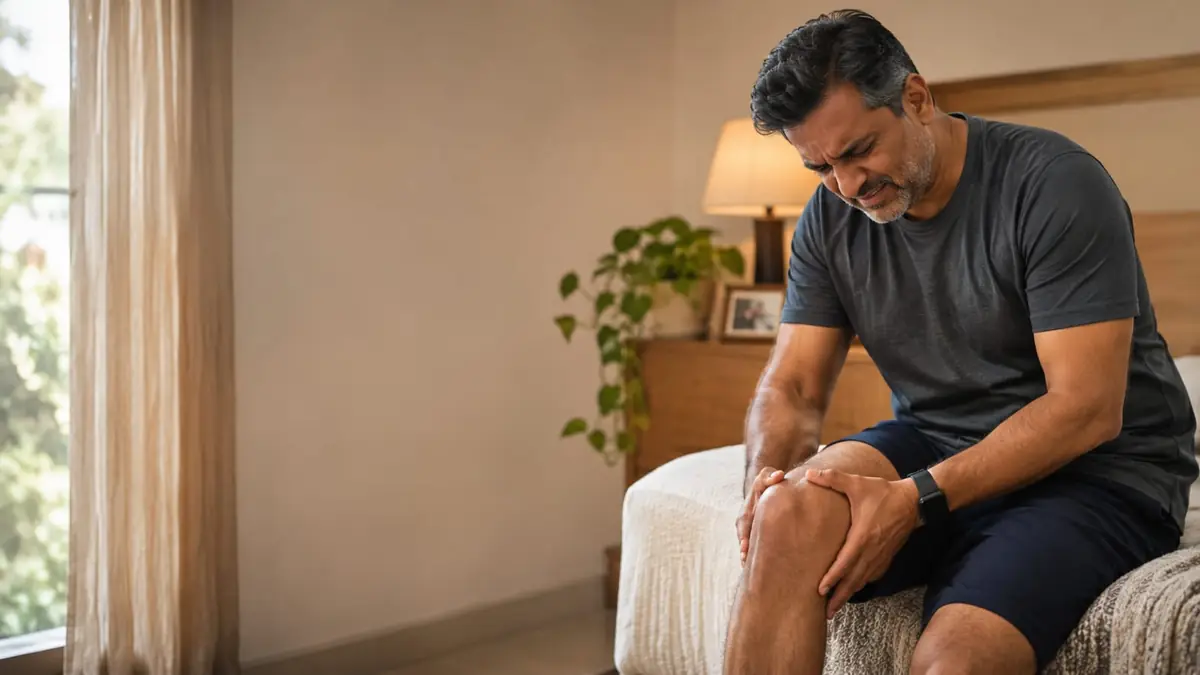
Before I started Kneesy Health, I spent close to seven years in clinical practice, and a lot of that time was in patients’ homes rather than in a clinic. If you want to understand what knee pain really does to a person, a home visit teaches you more than any textbook. You see the second-floor flat with no lift. The plastic chair kept next to the Indian-style toilet. The terrace nobody goes up to anymore. The family wedding someone skipped because the hall had steps and no railing.
Over those years I worked with more than 1,200 knee patients. Most of them said some version of the same sentence: “Ghutna ghis gaya hai, ab kya kar sakte hain?” The knee is worn out, what can anyone do now?
I started Kneesy because the honest answer to that question is: quite a lot. But first, it helps to see how big this problem actually is.
The numbers
Worldwide, about 595 million people were living with osteoarthritis (OA) in 2020, roughly 7.6% of the global population. The knee was the joint affected most often, and knee OA cases are projected to rise by about 75% by 2050 compared with 2020 [1].
India’s share of that is large and growing. Global Burden of Disease estimates show that the number of Indians living with OA went from about 23.5 million in 1990 to about 62.4 million in 2019. Knee OA was the most common type, and women were consistently affected more than men [2].
If you go looking for one exact Indian figure, you’ll find several, because studies use different age groups and different ways of diagnosing OA:
- A meta-analysis pooling 16 population-based studies put knee OA prevalence at about 20% [3].
- A community study across five sites found knee OA in 28.7% of participants, diagnosed using X-ray grading [4].
- A review of Indian studies found figures anywhere from 27% to 66%, depending on the minimum age of the people studied [5].
- A 2023 national health technology assessment cited a prevalence of around 22.9% in people aged 40 and above [6].
I don’t think the exact number matters as much as the picture. Roughly one in five to one in four Indian adults over 40 may have knee OA, and the share climbs steeply with age. In practice, almost every family has someone dealing with it.
Why it keeps going up
We’re living longer. More Indians are reaching their 60s, 70s and 80s, which are the years when OA is most common.
We’re heavier. Every extra kilo adds load to the knee with every step. Globally, high BMI contributed to roughly one in five cases of OA [1].
We move less. Desk jobs, two-wheelers and less everyday walking all weaken the thigh muscles that protect the knee.
Injuries and hard physical work. Indian researchers specifically name obesity, injuries and occupational stress as risk factors that can be targeted [2].
That last point is the one I want you to hold on to. Several of the biggest drivers of knee OA can be changed.
Women carry more of it
In Indian data, women are affected more often than men, and the risk rises with age [2][5]. Knee OA is also a major cause of mobility problems, particularly among women [4]. My colleague Yashashree has written a separate piece on this, because it deserves its own space: Why Knee Pain Is More Common in Women, and What You Can Do About It.
It’s never “just” knee pain
When knee OA gets ahead of you, it takes things away slowly. Walking to the market. Sitting on the floor for a puja or a family meal. Using an Indian-style toilet. Sleeping through the night. Over time it chips away at independence and, honestly, at mood. I’ve seen confident, active people become hesitant and withdrawn, not only because of the pain, but because of everything they stopped doing around it.
Because knee OA is so common, even a small improvement in how early people get care can help millions of them.
The part that gives me hope
The treatments with the strongest evidence for knee OA are mostly not surgical. Structured exercise, weight management, education and self-management support sit at the top of international guidelines [7]. None of these need a hospital bed, and all of them work better when they start early.
That’s the thinking behind Kneesy Health. Many people come to us late, after years of painkillers and advice from relatives, and often after being told either that surgery is the only way or that exercise alone will fix everything. Neither is true for everyone. What people need is one clear, honest recommendation that fits their knee, from a team that offers the whole range of care and so has no reason to push one option over another.
If you’re reading this because your own knees, or your parents’ knees, have started to complain, please don’t wait for it to get bad enough. Early is when the most can be done.
Quick answers
Is knee pain after 40 normal? It’s common. That’s not the same as normal, and it’s not something you simply have to accept. Pain that keeps coming back deserves a proper assessment, because early exercise-based care helps.
If my X-ray shows OA, will I need surgery? No. Plenty of people with knee OA do well without surgery, especially when they build leg strength and manage their weight. Dr. Rachit explains this in Knee Osteoarthritis, Explained by an Orthopaedic Surgeon.
References
- GBD 2021 Osteoarthritis Collaborators. Global, regional, and national burden of osteoarthritis, 1990–2020 and projections to 2050. Lancet Rheumatol. 2023;5(9):e508–e522.
- Singh A, Das S, Chopra A, et al. Burden of osteoarthritis in India and its states, 1990–2019: findings from the Global Burden of Disease Study 2019. Osteoarthritis Cartilage. 2022;30(8):1070–1078.
- Prevalence of knee osteoarthritis in India: a systematic review and meta-analysis of population-based studies. 2025. PubMed ID 41245277.
- Pal CP, Singh P, Chaturvedi S, Pruthi KK, Vij A. Epidemiology of knee osteoarthritis in India and related factors. Indian J Orthop. 2016;50(5):518–522.
- Thati S. Gender differences in osteoarthritis of knee: an Indian perspective. J Midlife Health. 2021;12(1):16–20.
- Department of Health Research, Government of India. Health Technology Assessment of Total Knee Replacement in Patients with Osteoarthritis Knee in India. August 2023.
- Kolasinski SL, et al. 2019 American College of Rheumatology/Arthritis Foundation guideline for the management of osteoarthritis of the hand, hip, and knee. Arthritis Rheumatol. 2020;72(2):220–233.
This article is for general education and does not replace advice from a qualified doctor or physiotherapist.