



Online Physiotherapy for Knee Pain: Does It Really Work?
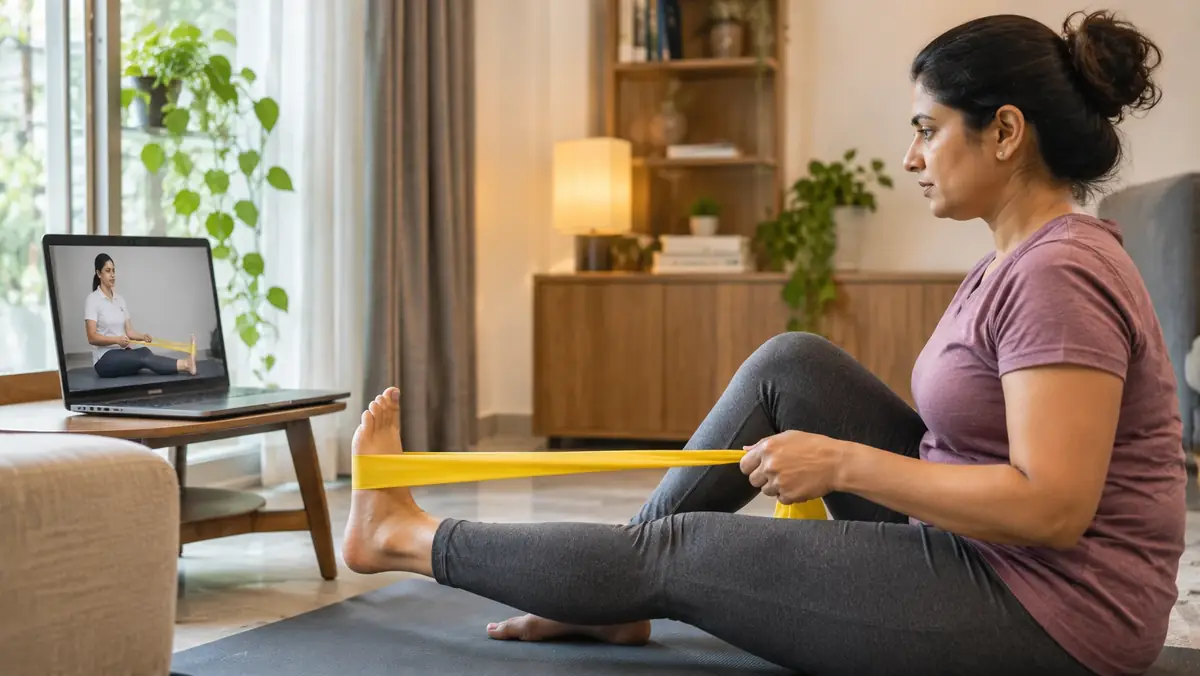
The first question almost every new patient asks me, sometimes politely and sometimes not, is: “How will you treat my knee without touching it?”
It’s a fair question. I’ve been doing online rehabilitation for more than five years, and I still think it deserves a straight answer rather than a sales pitch. So here it is: what the research shows, what I’ve seen work, and where online physio is not the right choice.
The real barrier is usually getting there
For most people with knee pain, the problem isn’t knowing that they should exercise. It’s getting to a physiotherapist regularly, for weeks. Clinic timings clash with work. Traffic eats an hour each way. An older parent needs someone to take them. And climbing into an auto with a painful knee is its own small ordeal.
Online physiotherapy, where a physiotherapist guides you over a live video call, removes most of those barriers. The real question is whether it keeps the results.
What the research says
The Melbourne trial (2017). Researchers in Australia ran a randomised trial with 148 adults aged 50 or older with chronic knee pain. Over three months, participants received educational material, seven video-call sessions with a physiotherapist for home exercise, and an online pain-coping skills programme. The approach produced clinically meaningful improvements in pain and physical function that lasted at least six months [1]. The researchers noted that the benefits were comparable to what is typically seen with in-person treatment, although the trial didn’t compare the two directly [2].
Telehealth with weight loss (2022). A later randomised trial in people with knee OA who were overweight or obese tested video-based physiotherapy alone, and physiotherapy combined with dietitian consultations, against online education only. The telehealth programmes reduced knee pain and improved function, and the authors described them as scalable, accessible ways to deliver the core care that guidelines recommend [3][4].
The bigger picture. A 2024 systematic review and meta-analysis of randomised trials found that telehealth-supported exercise and physical activity programmes reduced knee pain and improved physical function in people with knee OA [5].
Why “guided” is the important word
Exercise is the foundation of knee OA care, and the 2019 ACR/Arthritis Foundation guideline notes that exercise tends to give better results when it’s supervised [6]. That’s exactly what a good online session is: supervision. I’m watching your sit-to-stand and telling you your knee is drifting inward. I’m noticing that you’ve stopped wincing on the stairs and it’s time to progress. I’m also the person who notices when you’ve quietly skipped a week.
There’s one thing I actually prefer about online sessions. You learn your exercises in your own home, with your own chair and your own stairs, which is exactly where you’ll keep doing them. Patients who learn in a clinic full of equipment often struggle to repeat it at home. Online, that problem mostly disappears.
What works well online
- No travel, which matters a lot when walking or transport is difficult.
- Access to a knee specialist even if you live far from a big city.
- Easier to fit regular sessions around work, family and caregiving.
- You practise in the same space where you’ll keep exercising.
- Often more flexible and affordable than repeated clinic visits.
Where it falls short
I tell every patient this up front.
- I can’t physically examine or manually treat your knee over video. Some conditions need an in-person assessment.
- You need a stable internet connection, a smartphone or laptop, and a bit of floor space.
- Most of the strongest trials come from Australia. Evidence from Indian settings is still limited, so results here may differ.
- Online care is not for emergencies. More on that below.
When something in an online assessment tells us a patient needs to be seen in person, or needs a surgeon’s opinion, we say so. Online is a tool, not a belief system.
Who it suits best
In my experience, online physio works best for people with stable, long-term knee pain or diagnosed knee OA, for people recovering after surgery once their doctor has cleared them to exercise, and for anyone who needs ongoing support to keep exercising. That last group is bigger than people think. Most home programmes don’t fail in week one. They fail in week five.
How to get the most from your sessions
- Set up a clear space with a sturdy chair, a wall and a mat.
- Wear shorts or clothes that let your physiotherapist see your knee and leg move.
- Place your phone or laptop so your whole leg is in the frame. A stack of books works fine.
- Keep a simple pain and exercise diary. A note on your phone is enough.
- Do the home programme between sessions. Results come from consistency, not from the call itself.
- Tell us about any new swelling, night pain or locking.
When you need to be seen in person
Sudden severe swelling, a hot red knee, fever, a knee that locks or buckles, pain or swelling in the calf, or a recent fall or twisting injury all need an in-person assessment. Please don’t wait for your next video session for any of these.
Quick answers
Is online physiotherapy as good as clinic physiotherapy? For knee OA, trials suggest benefits similar to conventional care, but direct head-to-head evidence is limited. In my experience, the biggest factor is whether you keep doing the work.
Do I need equipment? Usually just a chair, a towel, and sometimes light ankle weights or a resistance band. We’ll tell you if you need anything else.
References
- Bennell KL, Nelligan R, Dobson F, et al. Effectiveness of an internet-delivered exercise and pain-coping skills training intervention for persons with chronic knee pain: a randomized trial. Ann Intern Med. 2017;166(7):453–462.
- University of Melbourne, Pursuit. Online approach works in treating knee osteoarthritis. Statements by Prof. Kim Bennell.
- Bennell KL, et al. Comparing video-based, telehealth-delivered exercise and weight loss programs with online education on outcomes of knee osteoarthritis: a randomized trial. Ann Intern Med. 2022;175(2):198–209.
- Healio. Telehealth programs improve outcomes in patients with knee osteoarthritis, obesity. 29 November 2021.
- Xiang XN, Wang ZZ, Hu J, et al. Telehealth-supported exercise or physical activity programs for knee osteoarthritis: systematic review and meta-analysis. J Med Internet Res. 2024;26:e54876.
- Kolasinski SL, et al. 2019 ACR/Arthritis Foundation guideline for the management of osteoarthritis of the hand, hip, and knee. Arthritis Rheumatol. 2020;72(2):220–233.
This article is for general education and does not replace advice from a qualified doctor or physiotherapist.